Upcoming
Francisco Mendes Moreira
UNLONELY
–
Alice Gallery is happy to present
Francisco Mendes Moreira
UNLONELY
Opening on November 12th from 5 to 9pm
In the presence of the artist
Exhibition : 13.10 - 12.12.2026
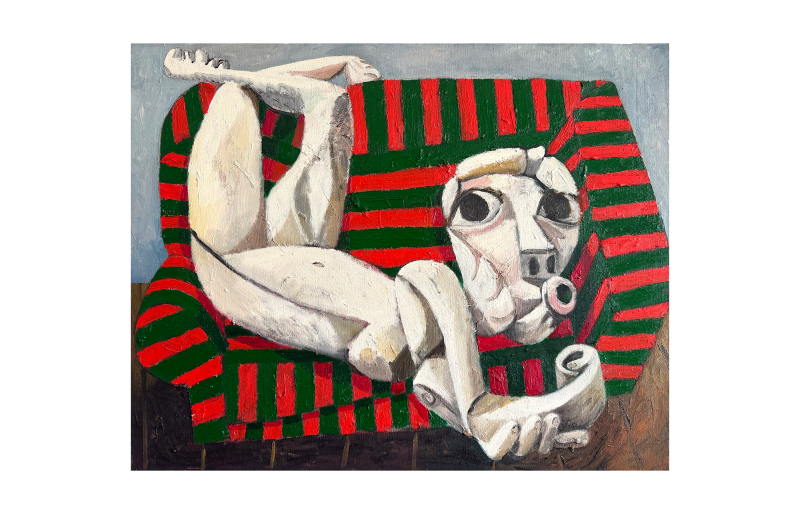
When you cast your eyes upon a painting by Francisco Mendes Moreira, you are like a commuter standing at the edge of the platform, resisting the pull of a high-speed train rushing past at full speed. His painting opens a window onto a vertiginous and hypnotic unconscious. What I mean by this is that a first glance is not enough to grasp the full extent of its magnetic power. The pictorial energy emanating from Francisco’s work reminds me of a sensation I experienced at the Museum of Modern Art when standing before a work by Max Beckmann, Max Ernst, Soutine and, of course, Picasso. Yet his universe may be closer to that of Frida Kahlo and René Magritte. The game of comparisons says more about the critic than about the painting itself, but the superlative nature of these comparisons reflects my conviction of the artistic excellence of the subject I am defending here.
The artist works “from imagination” without preparatory drawings, one canvas after another, with only a very vague idea of a subject: a dancer, a woman sitting on a bench, the song of the sirens in the Odyssey… Whether or not he strays from that initial idea is of no importance, because he follows his intuition in a mental dialogue between himself and the canvas, which has often previously served to test the colours for the preceding painting. On the one hand, his experience guides his hand in the composition and provides him with a pictorial repertoire of shapes and faces. On the other, he allows himself to be led astray by whatever subject might emerge from the chaos before his eyes. This routine relies on the long stretches of time that the act of painting offers for reflection. Francisco Mendes Moreira moves forward through the fog until it lifts, revealing an unexpected destination. It is not a linear creative process and, for this reason, one should not look for a hidden message in the landscape. It is not, in the manner of Dalí, the memory of a dream promising a fortune to the psychoanalyst who manages to decipher it. On the contrary, one should let one’s imagination follow all the paths suggested by the painting and arrive at one’s own interpretation. In other words, I am writing far too much simply to tell you that with a painting by Francisco Mendes Moreira, everyone makes their own movie.
I will end this presentation with an impressionistic portrait of the artist, drawn from the conversations and observations that stayed with me after the sunny day Raphaël and I spent at his home in Lisbon, in the company of his wife, Maria, and the fleeting presence of three of their five children. He lives on the second floor of an Art Deco apartment. There is a gentle smell of oil paint, the parquet floor is old, and beautiful light filters through the windows of the living room. There, he hangs the paintings he wants to show us, one after another, from a nail in the wall, while on other stretches of wall he leaves them to dry. His studio is on a plot of garden. He reaches it via a staircase from the kitchen, offering, along the way, a commanding view over the city. The rudimentary workspace is covered by corrugated metal sheeting and is completely open on one side. He can paint two canvases at a time. Just outside, beneath a bamboo pergola, there is a long table around which we spent hours talking.
Francisco Mendes Moreira has been painting since his adolescence, and it was only as he approached forty, that he decided to try to make a living from his art. The path he travelled beneath the radar of the art market, he says, allowed him to understand just how essential painting was to his life, while also making him immune to the influence of the market on his work. The artist has limited his library to ten books, which he rereads tirelessly. Among them are Don Quixote, The Odyssey, Moby-Dick, On the Road and Treasure Island. So many novelistic invitations to experience life through adventure. And that is probably what Francisco Mendes Moreira loves about painting: the journey rather than the destination.
Alice Gallery est heureuse de présenter
Francisco Mendes Moreira
UNLONELY
Vernissage le 12 NOvembre de 17 à 21h
En présence de l'artiste
Exposition : 13.10 - 12.12.2026
Lorsque vous posez le regard sur un tableau de Francisco Mendes Moreira, vous êtes comme ce navetteur qui, au bord du quai, résiste à l’aspiration du TGV passant à toute vitesse. Sa peinture ouvre une fenêtre sur un inconscient vertigineux et hypnotique. Je veux dire par là que le premier coup d’œil ne suffit pas à prendre la mesure de son pouvoir attractif. L’énergie picturale qui se dégage chez Francisco me rappelle une sensation éprouvée au musée d’art moderne devant une œuvre de Max Beckmann, de Max Ernst, de Soutine et, bien sûr, de Picasso. Mais l’univers serait plus proche de celui de Frida Kahlo et de René Magritte. Le jeu des comparaisons en dit plus sur le critique que sur la peinture elle-même, mais son pouvoir superlatif souligne la conviction de l’excellence artistique du sujet ici défendu.
L’artiste travaille "d’imagination", sans dessin préparatoire, une toile après l’autre, avec une très vague idée de sujet, comme une danseuse, une femme assise sur un banc, le chant des sirènes dans l’Odyssée… S’il s’en écarte ou non, cela n’a pas d’importance, car il suit son intuition dans un dialogue mental entre lui et la toile, qui a souvent servi préalablement à tester les couleurs de la peinture précédente. D’un côté, son expérience guide la main pour la composition et apporte un répertoire pictural de formes et de visages. De l’autre, il se laisse dérouter par tout sujet qui surgirait du chaos devant ses yeux. Cette routine repose sur le temps long offert à la réflexion par l’exercice de la peinture. Francisco Mendes Moreira avance dans le brouillard jusqu’à ce qu’il se lève sur une destination inattendue. Ce n’est pas un processus créatif linéaire et, pour cette raison, il ne faut pas chercher un message caché dans le paysage. Ce n’est pas, à la manière d’un Dalí, le souvenir d’un rêve qui promet une fortune au psychanalyste qui saura l’analyser. Au contraire, il faut laisser son imagination emprunter toutes les pistes suggérées par le tableau pour arriver à sa propre interprétation. En d’autres mots, j’en écris de trop pour simplement vous dire qu’avec une toile de Francisco Mendes Moreira, chacun se fait son propre cinéma.
Je termine cette présentation par un portrait impressionniste de l’artiste à partir des discussions et des observations qui me restent de notre journée ensoleillée passée avec Raphaël chez lui, à Lisbonne, en compagnie de sa femme, Maria, et de la présence furtive de trois de leurs cinq enfants. Il vit au deuxième étage, dans un appartement de style Art déco. Il y a une douce odeur d’huile, le parquet est ancien et une belle lumière se glisse par les fenêtres du salon, où, sur un clou, il accroche successivement les tableaux à montrer, tandis que, sur d’autres pans de murs, il les fait sécher. Son atelier se trouve sur une parcelle de jardin. Il y accède par une cage d’escalier depuis la cuisine et offre, au passage, une vue en surplomb sur la ville. L’espace de travail rudimentaire est couvert d’une tôle et entièrement ouvert sur un côté. Il peut y peindre deux toiles à la fois. Juste devant, sous une pergola en bambou, il y a une longue table autour de laquelle nous avons passé des heures à discuter.
Francisco Mendes Moreira peint depuis son adolescence et ce n’est qu’à l’approche de la quarantaine, qu’il a décidé d’essayer de vivre de son art. Le chemin parcouru sous les radars du marché lui a, dit-il, permis de mesurer à quel point la peinture était essentielle dans sa vie, tout en l’immunisant contre l’influence du marché sur son travail. L’artiste a limité sa bibliothèque à dix livres qu’il relit inlassablement, parmi lesquels on retrouve Don Quichotte, l’Odyssée, Moby Dick, On the Road, L’Île au trésor. Autant d’invitations romanesques à éprouver la vie par l’aventure. Et c’est sans doute cela que Francisco Mendes Moreira aime dans la peinture : le chemin plutôt que la destination.

